How to Price Artwork: A Practical Guide for Emerging and Established Artists
What this helps you do
Reach a consistent starting price and keep the reasoning with the work.
Pricing artwork feels personal because it is personal. Your prices carry your labor, your confidence, your market position, and your future relationships with collectors. A workable pricing system should feel defensible and consistent.
Start with consistency, not perfection
Many artists look for a single perfect formula. In reality, pricing is a framework, not a magic number. The goal is to arrive at prices that are consistent enough to build trust and flexible enough to reflect changes in size, labor, demand, and venue.
The biggest pricing mistakes usually come from inconsistency. One collector pays one amount, a gallery sees a different amount, and your website shows something else entirely. That kind of drift makes sales harder, not easier.
Common ways artists price artwork
Most artists combine several methods rather than relying on only one. Here are the most common approaches.
- Size-based pricing: Useful when you produce work in repeatable formats. This helps keep pricing internally consistent.
- Time and materials: Helpful when estimating a base cost, especially for commissions or labor-intensive work.
- Market comparison: Compare your pricing to artists at a similar career stage, working in a similar medium and market.
- Career-stage pricing: Early-career artists often keep pricing tighter and raise it in deliberate increments as demand and exhibition history grow.
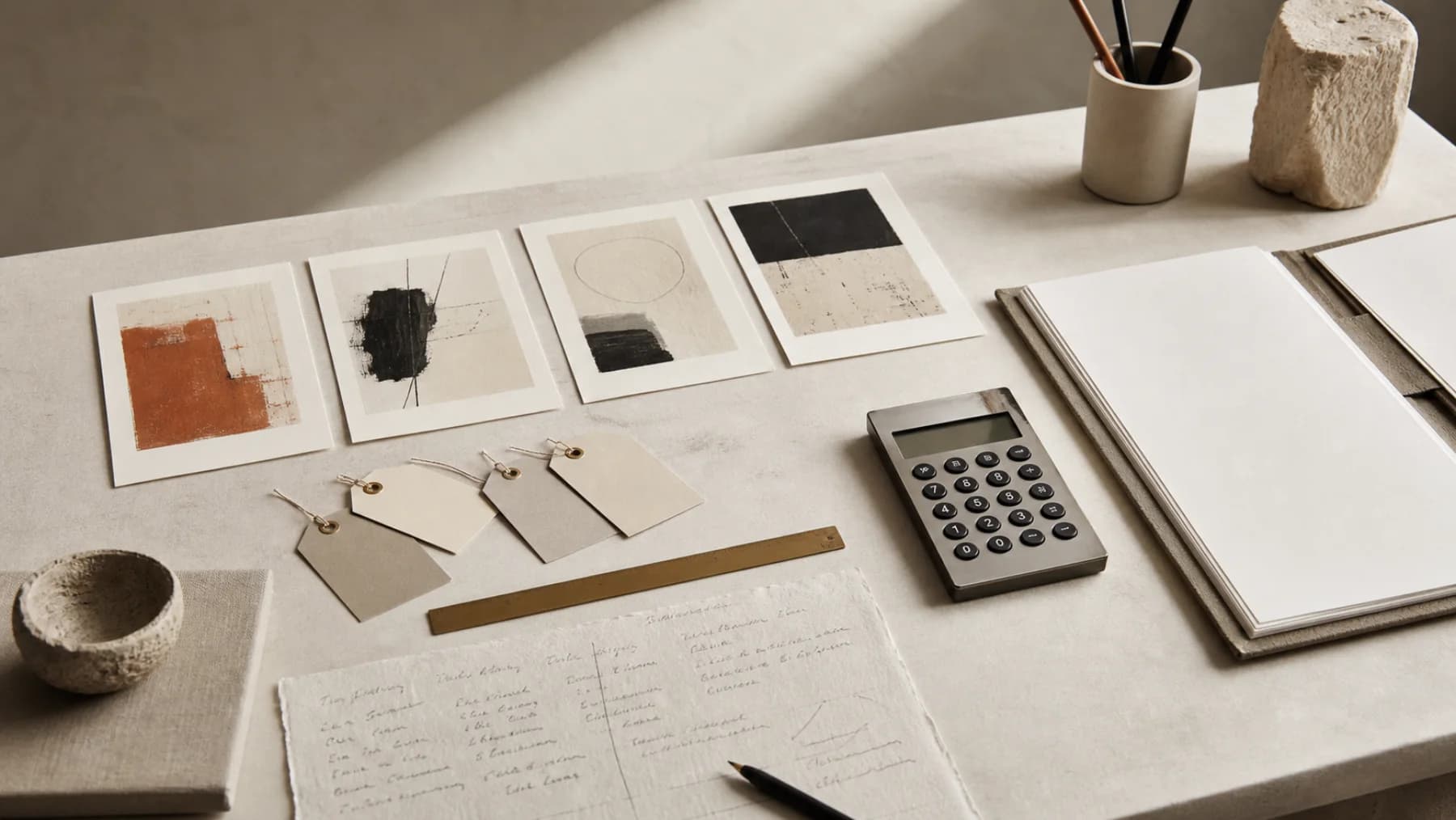
No single method is sufficient on its own. Size alone ignores labor. Time alone ignores market context. Comparison alone can make you chase other people's pricing logic instead of building your own. If you want to test a baseline against a new size, use the free artwork pricing calculator. Its dimensions, currency, and rounded price can stay in the same browser for up to 24 hours and prefill your first artwork after signup. You still add a title, check the details, and save it yourself; the formula and adjustments are not carried over.
A simple process that artists can actually use
- Group your work by medium and format.
- Set a baseline pricing structure for each group, such as price by size range.
- Check that structure against your labor, materials, and recent comparable sales.
- Adjust for special factors such as framing, complexity, or whether a piece anchors a series.
- Record the final price in one system so you are not guessing later.
The final step is the one artists skip most often. If your prices live in memory, they change depending on mood, pressure, or who is asking. If they live in records, they become easier to defend.
How galleries affect pricing
Gallery representation does not just change where your work is shown. It changes the context in which your prices are judged. Galleries expect stable pricing across direct and represented sales. Undercutting a gallery by offering lower direct prices damages trust quickly.
This is why artists benefit from keeping a clear record of retail price, consignment terms, discounts granted, and final sale price. Once your work moves through more than one channel, memory is not enough.
What should make a price go up
Price increases should feel earned and legible. Good reasons include stronger sales history, sustained demand, notable exhibitions, serious press, or a consistent body of work that has clearly advanced in scale or ambition.
What does not usually help is making random jumps because a piece took a long time or because you suddenly feel underpriced after one strong response. Price changes work best when they are incremental and repeated across a body of work, not improvised piece by piece.
Records every artist should keep
Strong pricing depends on strong documentation. At minimum, keep a record of list price, sale price, date sold, buyer or gallery, commission rate, and whether the sale was direct or consigned.
Over time, this becomes your pricing history. It tells you which sizes move fastest, where discounts were offered, and whether your pricing structure still matches reality. It also makes future pricing decisions less emotional. Keeping pricing and sales history attached to each artwork record is one of the simplest ways to make pricing decisions feel more grounded.
A final rule worth following
Choose a pricing method you can explain in one sentence. That is a useful test. If your system is too complicated to explain, it will probably be too complicated to maintain.
Collectors do not need a full spreadsheet of your logic, but they do need to feel that your prices are coherent. Galleries need that even more. Professional pricing is not about sounding impressive. It is about being consistent enough that people trust the structure behind the work.
Keep your prices consistent across every sale
Artwork Codex lets you store pricing, track sales history, manage contacts, and generate polished PDFs from the same artwork records.
Paid checkout requires a card. Cancel anytime. The Free plan remains available without a card.
The Free plan includes sales records and one COA. Studio adds private artwork documents and unlimited COAs.